
To strengthen the foundation of cultural confidence and foster a sense of responsibility among youth through the wisdom of business and craftsmanship, the Business School recently organized more than 80 participants from its Youth Training Program to visit the China National Museum of Fine Arts. There, they engaged in a thematic practical activity titled “Craftsmanship Endures Forever: Passing on the Flame.” The event took place during the ongoing exhibition “The Spirit of the Age: The Seventh China Contemporary Craft Art Biennale,” which showcased over 720 nationally significant craft art masterpieces. These works were presented alongside a special exhibition on Dunhuang costume culture, together offering students a profound and immersive cultural experience that bridges millennia of Chinese artistic heritage.
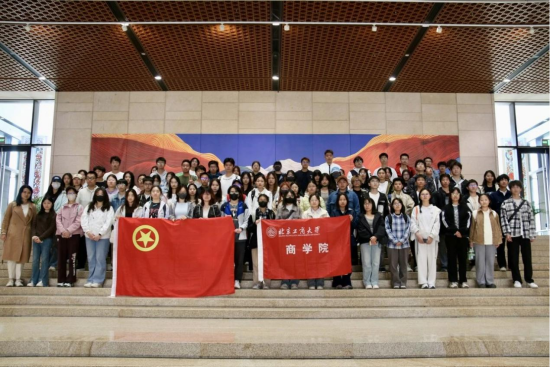
Discover National Treasures, Feel the Warmth of Heritage
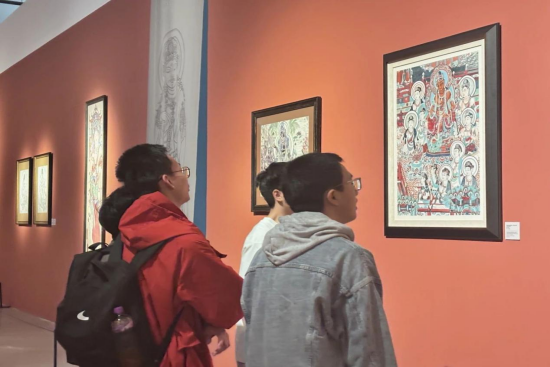
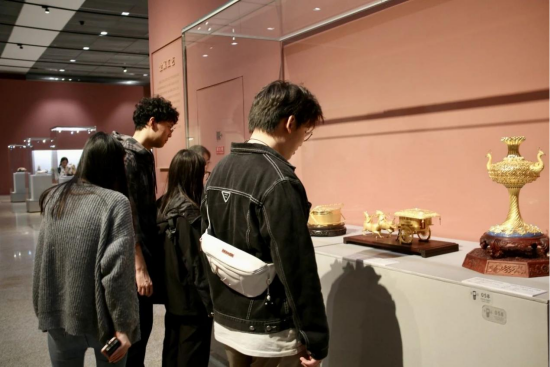
Upon entering the exhibition hall, participants of the Youth Training Program were immersed in the pinnacle of Chinese craft aesthetics. From the 368-kilogram jade carving “Daiyue Qiguan” to the exquisitely crafted incense burner “Hanxiang Juyi,” produced using intricate nested carving techniques, the four museum centerpiece works exemplify the Eastern philosophical concept of “qi yǐ zài dào” (the vessel carries meaning) through their monumental scale and masterful artisanship. In the biennale section, innovative works by 809 artists breathe new life into traditional forms: contemporary sculptures that integrate metalworking with digital fabrication, and textile pieces that reimagine Dunhuang motifs, enabled participants to gain profound insight into the principle of “preserving heritage while embracing innovation.”
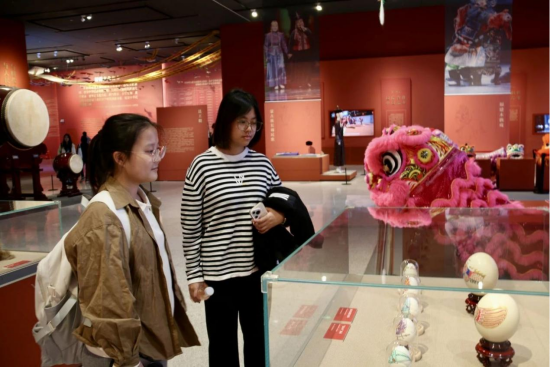
The exhibition featured a specially designed immersive experience zone. In the woodblock New Year painting workshop, participants created rubbings of Tang Dynasty flying apsaras adorned in flowing robes, gaining firsthand appreciation of traditional printmaking techniques. Through assembling the Lu Ban lock, they experienced the philosophical depth of mortise-and-tenon joinery—a craftsmanship principle embodying seamless integration and structural harmony. At the Dunhuang Costume Culture exhibition, 369 meticulously reconstructed garments—developed over a seven-year research and restoration effort—served as historical narratives woven through textile patterns. These pieces enabled participants to trace the grand tapestry of Silk Road cultural exchange through the intricate weft and warp of brocade. “When our fingertips touch the golden threads of kesi silk,” remarked several participants, “it feels as though we are connecting with the master artisans of ancient times.”
Carry Forward Cultural Legacy, Fulfill the Mission of Business Education
The exhibition served not only as a profound cultural experience but also as an insightful case study in business innovation. As participants engaged with the exquisite craftsmanship on display, they reflected deeply on the integration of business disciplines with traditional cultural heritage. At the Su embroidery exhibit, Chen Xinglin, an outstanding participant in the Youth Training Program, paused before a double-sided embroidered screen featuring contrasting colors and remarked, “Intangible Cultural Heritage (ICH) crafts can generate cultural added value through intellectual property development. By transforming traditional motifs into contemporary brand design elements, we as business students can identify innovative pathways for cultural empowerment.” Zhang Rui, focusing on digital transformation, observed the intricate process of kesi (tapestry) weaving and noted, “There is a deep alignment between the artisan’s ethos and the principles of lean management in modern business. Leveraging digital technologies, we can apply business frameworks to create immersive, experience-driven platforms for ICH products—bridging tradition and commerce in a sustainable way.”
By integrating theoretical study with practical experience, participants in the Youth Training Program have strengthened both their professional competence and cultural confidence, while identifying concrete pathways to fulfill their responsibilities as young leaders. Looking ahead, business students can apply their disciplinary expertise in fields such as cultural intellectual property (IP) development, the industrialization of intangible cultural heritage, and the integration of culture, tourism, and creative industries. In doing so, they can help embed millennia-old wisdom within contemporary commercial ecosystems, fostering a synergistic balance between cultural preservation and economic value creation.
This training initiative represents not only a cultural decoding endeavor through a business lens, but also a visionary journey in which youth contribute to civilizational continuity by applying business logic to heritage revitalization. Moving forward, aspiring members of the Communist Youth League are expected to advance with greater determination along the path of inheriting and promoting China’s outstanding traditional culture, crafting meaningful legacies through dedication, innovation, and sustained effort.